

Monthly budget:
Managing money can feel overwhelming when you don’t have a clear picture of where your income actually goes. You get paid, pay your bills, buy groceries, cover transportation, make a few online purchases, and then somehow find yourself wondering where the rest of your money went.
This is exactly the problem a monthly budget is built to solve.
A budget isn’t just a list of expenses sitting on a page. It’s a plan for your money. A good one helps you understand how much is coming in, where it needs to go, how much you can realistically save, and which spending habits might need a second look.
The Consumer Financial Protection Bureau suggests starting with an honest, realistic picture of your income, your spending, and your bill schedule before you try to build a working budget.
Here’s the good news: you don’t need fancy software or a finance degree to get started. A notebook, a simple spreadsheet, or even a basic budgeting app is enough.
In this guide, we’ll walk through the whole process, one step at a time.
What Is a Monthly Budget?
A monthly budget is simply a plan for how you intend to use your money over the course of a month.
It generally covers three basic areas:
Money coming in Money going out Money set aside for savings or financial goals
Say, for example, someone brings in 100,000 in a given month. Their budget might split that between housing, food, transportation, utilities, debt payments, savings, and personal spending.
The exact split will look different for everyone, simply because everyone’s income, responsibilities, location, and goals are different.
And that’s really the point: your budget should be built around your actual life, not someone else’s.
Why Is a Monthly Budget Important?
A lot of people assume budgeting is only necessary once money gets tight. In reality, it can be just as useful even when your income feels comfortable.
Without any kind of plan, small expenses have a way of quietly piling up.
A coffee here, a random online purchase there, a forgotten subscription, a few too many restaurant meals — by the end of the month, it adds up to something noticeable.
A budget gives you visibility into all of that.
Instead of asking:
“Where did my money go?”
you get to ask:
“Did my money go where I planned for it to go?”
That shift alone can make managing money a lot less stressful.
A budget also helps you spot chances to save, get ready for surprise expenses, and work steadily toward bigger financial goals. The CFPB describes budgeting as a helpful way to get a clearer sense of your income and spending while you work toward your savings goals.
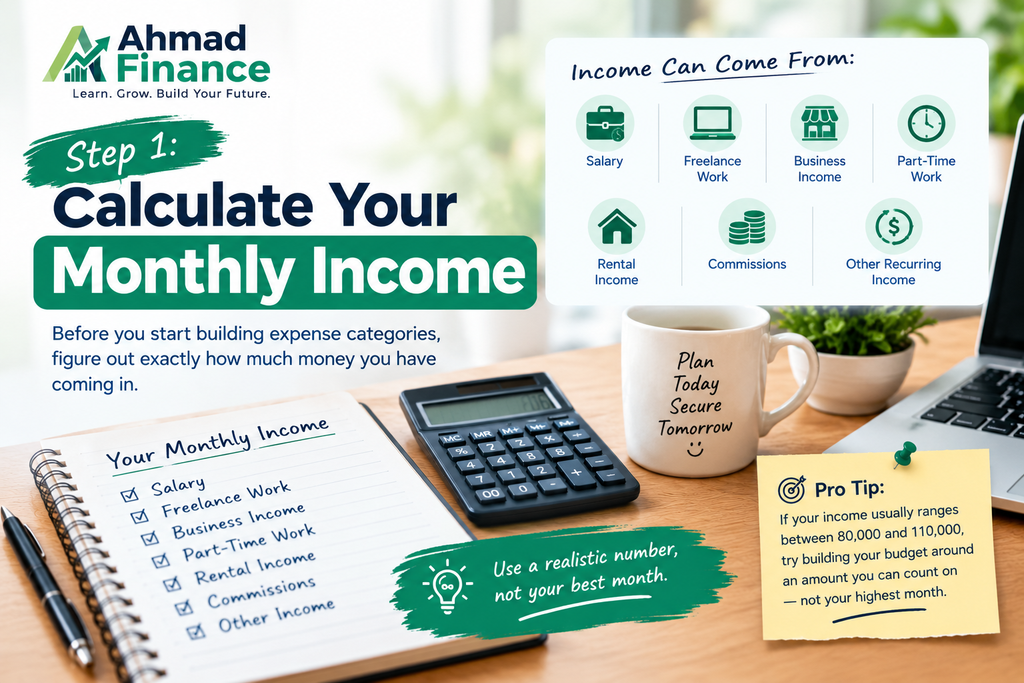
Step 1: Calculate Your Monthly Income
Before you start building expense categories, figure out exactly how much money you have coming in.
If you’re on a fixed salary, this part is usually pretty straightforward.
But for a lot of people, income comes from more than one place:
Salary Freelance work Business income Part-time work Rental income Commissions Other recurring income
If your income shifts from one month to the next, resist the urge to build your budget around your best month ever.
Instead, work with a conservative number based on what you typically bring in.
For instance, if your income usually lands somewhere between 80,000 and 110,000, building your plan around 110,000 is asking for trouble during a slower month.
A safer bet is to build your core monthly plan around an amount you can count on.
Step 2: List Your Fixed Expenses
Next, pin down the expenses that stay more or less the same every single month.
These are usually called fixed expenses.
A few common examples:
Rent or mortgage Loan payments Insurance School or tuition payments Internet bills Certain subscriptions Regular service payments
Write each one down along with its monthly amount.
For instance:
Expense Monthly Amount Rent 30,000 Internet 3,000 Loan payment 8,000 Insurance 4,000 Subscriptions 2,000
Total fixed expenses: 47,000
Your own numbers will look nothing like this, and that’s fine.
The point of this step is simply to understand how much of your income is already spoken for before you even get to the flexible stuff.
Step 3: Track Your Variable Expenses
This is usually where people get a little surprised.
Variable expenses change from month to month.
Think:
Groceries Fuel Transportation Restaurants Clothing Entertainment Shopping Gifts Personal care Household purchases
These are trickier to manage because they don’t come as neat, predictable bills.
For at least one full month, try to write down every single purchase you make.
Don’t worry about changing anything yet — just collect the information first.
Spent 500 on something small? Write it down.
Spent 5,000 on groceries? Write it down.
Paid for an online subscription? Write it down too.
The whole point is to figure out your actual spending pattern instead of guessing at it.
The CFPB recommends tracking your spending over time so you can start noticing where adjustments might actually be possible.
Step 4: Separate Needs From Wants
One of the most useful things you can do in monthly budgeting is draw a clear line between what you need and what you simply want.
A need is generally something tied to your basic responsibilities.
That might include:
Housing Basic food Essential transportation Utilities Required debt payments Necessary healthcare
Wants, on the other hand, are things that make life a little nicer but aren’t essential.
Think:
Expensive restaurants Entertainment New gadgets Non-essential clothing Premium subscriptions Impulse purchases
This doesn’t mean you’re supposed to cut out every single want.
That would make most budgets impossible to stick to.
Instead, give yourself a reasonable, honest amount for discretionary spending.
A budget that leaves zero room for enjoyment is a budget that tends to fall apart pretty fast.
Step 5: Give Savings a Place in Your Budget
One mistake people make constantly is treating savings as whatever happens to be left over at the end of the month.
More often than not, nothing is left over.
Instead, try to make savings a deliberate part of the plan right from the start.
For example:
Income → planned expenses → savings → discretionary spending
The exact order can shift depending on your situation, but the key is giving savings an actual seat at the table in your monthly plan.
You could break it down into separate goals, like:
Emergency savings Short-term purchases Education Travel Home-related expenses Long-term financial goals
Even a small, consistent amount can help build the habit.
The CFPB points out that setting money aside regularly — even in small amounts — can help people gradually build up emergency savings.
Step 6: Build an Emergency Fund
An emergency fund is money you keep specifically for the unexpected.
Things like:
A major car repair An unexpected home repair A medical expense A temporary loss of income An urgent family expense
This money isn’t meant for regular shopping or planned entertainment.
It exists purely to help you handle life’s financial curveballs.
There’s no single “correct” emergency-fund number that works for everyone. What you need depends on your income, your expenses, your job situation, your family responsibilities, and your own circumstances.
The CFPB specifically encourages people to think about their own situation and the kinds of unexpected expenses they’re likely to face, rather than assuming one fixed number applies across the board.
If saving a large amount feels completely out of reach right now, start smaller.
Your first goal could just be a modest cash cushion.
Once you hit it, set the next target.

Step 7: Use Automatic Savings When Possible
Saving consistently is hard when it depends purely on willpower.
One way to make it easier is automation.
You could, for example, set up a fixed amount to move automatically from your everyday account into a savings account on a regular basis.
That way, you’re not relying on yourself to remember every single month.
The CFPB points to automatic recurring transfers as a practical way to make saving more consistent.
That said, automation shouldn’t turn into an excuse to stop watching your account balance.
Make sure the amount you’re transferring actually fits your cash flow, so the automatic transfer doesn’t end up creating a new problem of its own.
Step 8: Create a Realistic Food Budget
Food is one of those categories where spending can spiral without you even noticing.
Start by looking back at what you actually spent last month.
Then break it into two separate buckets:
Groceries
versus
Eating out and delivery
This split matters because these two categories tend to behave very differently.
Someone might assume they’re spending 20,000 a month on food, but once they actually check their transactions, the real picture might look like:
Groceries: 13,000 Restaurants: 5,000 Delivery: 4,000
Now there’s something concrete to work with.
Instead of a vague:
“I need to spend less.”
you get something specific:
“I’ll cut delivery spending by 2,000 next month.”
Specific targets are just easier to actually track.
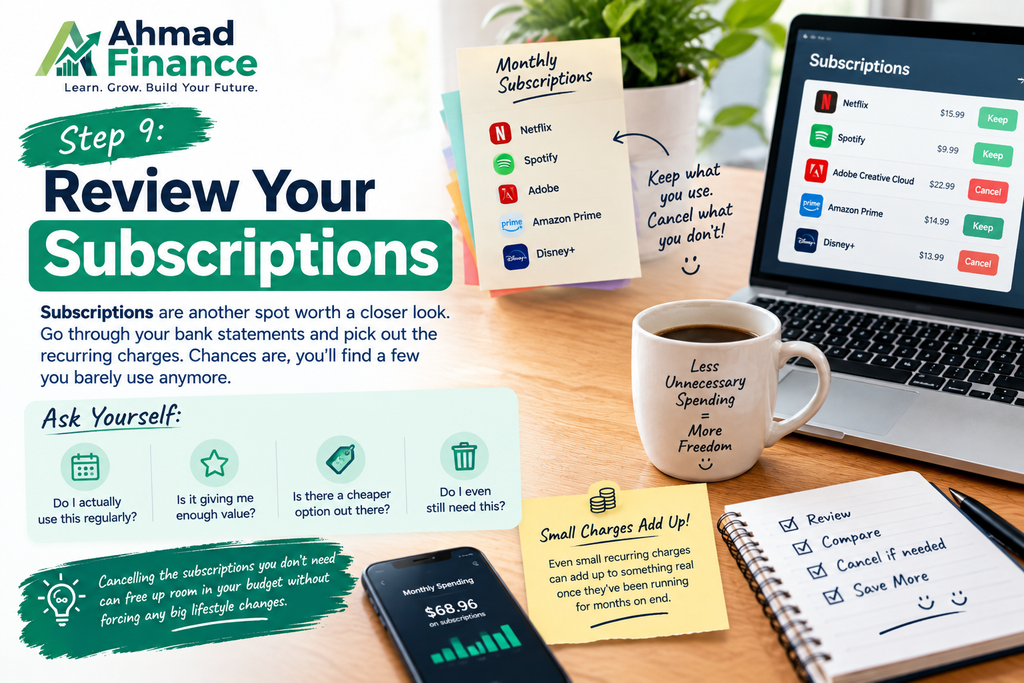
Step 9: Review Your Subscriptions
Subscriptions are another spot worth a closer look.
Go through your bank statements and pick out the recurring charges.
Chances are, you’ll find a few you barely use anymore.
For each one, ask yourself:
Do I actually use this regularly? Is it giving me enough value? Is there a cheaper option out there? Do I even still need this?
Cancelling the subscriptions you don’t need can free up room in your budget without forcing any big lifestyle changes.
Small recurring charges add up to something real once they’ve been running for months on end.
Step 10: Create a Weekly Spending Limit
A monthly budget can sometimes feel too big and abstract to actually manage day to day.
You might have 20 days left in the month with zero sense of whether you’re on track or not.
One fix is to break certain flexible spending down into weekly limits instead.
For example, if you’ve set aside 20,000 for discretionary spending, you could turn that into a rough weekly guideline.
It doesn’t need to be split perfectly evenly across every week.
The point is simply to create checkpoints along the way.
At the end of each week, ask yourself:
How much did I spend? Was that spending planned? Do I need to adjust anything for next week?
That turns your budget into something you’re actively using, instead of a document you wrote once and forgot about.
Step 11: Don’t Forget Irregular Expenses
Some expenses don’t show up every single month.
That doesn’t mean you get to ignore them.
Think about things like:
Annual insurance School fees Vehicle maintenance Gifts Holidays Property expenses Annual subscriptions Seasonal purchases
If your budget only accounts for the regular monthly bills, these kinds of expenses will catch you off guard eventually.
Instead, estimate the total yearly cost and break it down into a monthly amount.
For example, if a yearly expense adds up to 24,000, you could think of it as roughly 2,000 a month for planning purposes.
You don’t necessarily have to set aside 2,000 every single month.
The idea is simply to see the expense coming before it actually arrives.
Step 12: Deal With Debt Carefully
Debt payments need a clear, defined spot in your budget.
Write down:
Outstanding balance Minimum payment Interest or financing cost Payment due date
Once you’ve laid all that out, you can put together a repayment plan that’s actually realistic.
Try not to set an overly aggressive debt-payoff target that leaves you short on money for basic living expenses.
At the same time, don’t push debt to the back burner entirely.
A realistic budget makes room for both your everyday living costs and your longer-term financial commitments.
Step 13: Review Your Budget Every Month
Your first attempt at a budget almost certainly won’t be perfect.
And that’s completely normal.
Your expenses will shift.
Your income might shift too.
Your priorities will change over time.
That’s exactly why a good budget needs regular check-ins.
At the end of each month, compare:
Planned spending vs. actual spending
For example:
Category Planned Actual Groceries 15,000 16,200 Transport 8,000 7,300 Entertainment 5,000 7,000 Savings 10,000 10,000
This tells you a lot more than simply glancing at your bank balance.
You get to see exactly where your original assumptions held up, and where they need to be adjusted going forward.
Common Monthly Budgeting Mistakes
- Making the budget too complicated
You don’t need 50 different categories.
Start with the big, obvious ones.
You can always add more detail later if it’s genuinely helpful.
- Forgetting irregular expenses
Annual or seasonal costs can quietly wreck an otherwise solid monthly plan.
Make sure they’re accounted for.
- Setting unrealistic limits
If you normally spend 20,000 on groceries, suddenly slashing that to 5,000 probably isn’t going to stick.
Aim for gradual, realistic changes instead.
- Ignoring small purchases
Small purchases matter more than people think, simply because they add up.
Track them too.
- Treating savings as leftover money
If savings genuinely matter to you, they deserve a planned, dedicated spot.
- Giving up after one bad month
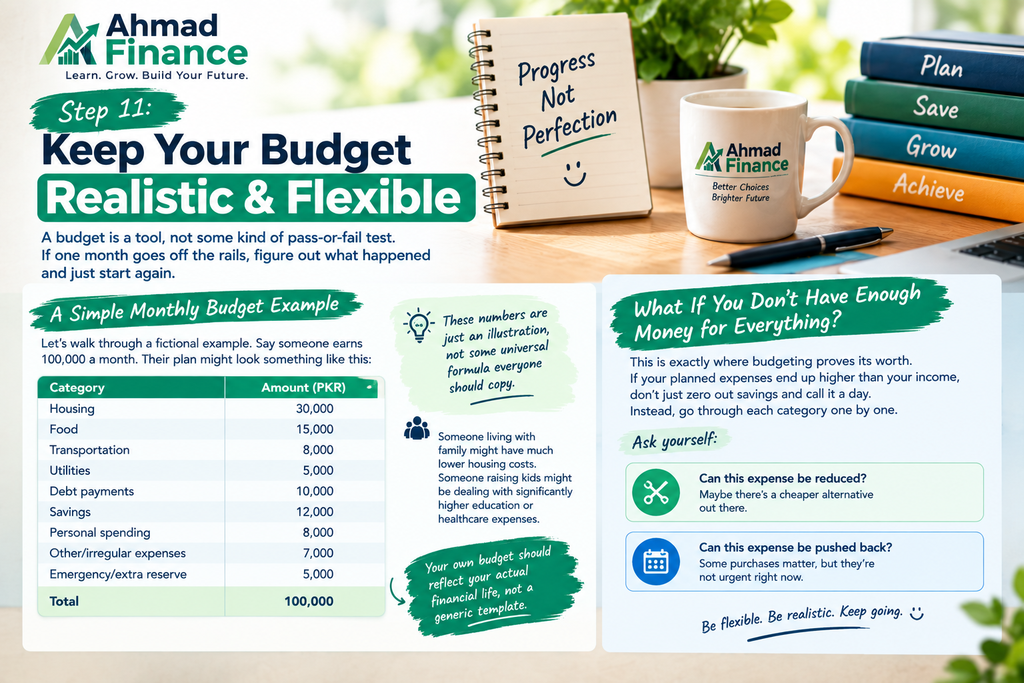
A budget is a tool, not some kind of pass-or-fail test.
If one month goes off the rails, figure out what happened and just start again.
A Simple Monthly Budget Example
Let’s walk through a fictional example.
Say someone earns 100,000 a month.
Their plan might look something like this:
Category Amount Housing 30,000 Food 15,000 Transportation 8,000 Utilities 5,000 Debt payments 10,000 Savings 12,000 Personal spending 8,000 Other/irregular expenses 7,000 Emergency/extra reserve 5,000
These numbers are just an illustration, not some universal formula everyone should copy.
Someone living with family might have much lower housing costs. Someone raising kids might be dealing with significantly higher education or healthcare expenses.
Your own budget should reflect your actual financial life, not a generic template.
What If You Don’t Have Enough Money for Everything?
This is exactly where budgeting proves its worth.
If your planned expenses end up higher than your income, don’t just zero out savings and call it a day.
Instead, go through each category one by one.
Ask yourself:
Can this expense be reduced?
Maybe there’s a cheaper alternative out there.
Can this expense be pushed back?
Some purchases matter, but they’re not urgent right now.
Can the payment schedule be adjusted?
For certain bills, reaching out to the provider might help shift the due date closer to when your cash flow actually allows it. The CFPB notes that adjusting bill due dates can sometimes make it easier to manage tighter periods.
Can income be increased?
Depending on your situation, extra work, freelance gigs, or other legitimate income sources might be worth exploring.
The goal here is to understand the gap honestly, not paper over it.
How to Make Your Monthly Budget Easier to Follow
A budget only works if it’s actually easy to use.
You could go with:
A simple spreadsheet A notebook A budgeting app A banking tool Some mix of the above
The best method is whichever one you’ll actually stick with.
You don’t need to be checking your budget every hour of every day either.
A quick weekly check-in is enough for most people, followed by a more thorough monthly review.
What really matters is consistency, not perfection.
Final Thoughts
Building a monthly budget doesn’t mean giving up on enjoying your money.
The whole point is to understand your financial situation and make decisions on purpose, rather than by accident.
A solid budget helps answer a few simple but important questions:
How much money do I actually have?
Where is it going?
How much can I realistically save?
Which expenses could I change?
What am I actually working toward?
You don’t need to nail the perfect budget on your very first try.
Start with your real income.
Track your actual expenses.
Separate what’s essential from what’s discretionary.
Give savings a real place in the plan.
Prepare for the irregular expenses too.
Then review how it went, and adjust from there.
Financial habits are built gradually, over time. A simple budget you actually stick to every month tends to be far more useful than a complicated plan you abandon after a week.
The goal was never perfection.
It’s awareness, consistency, and making better decisions with your money.
SEO details for WordPress
Focus keyword: monthly budget
SEO Title: How to Create a Monthly Budget That Actually Works
Slug: how-to-create-a-monthly-budget
Meta description: Learn how to create a monthly budget that fits your income, controls spending, builds savings, and helps you make better financial decisions.
Suggested categories: Personal Finance → Budgeting
Suggested tags: monthly budget, budgeting, personal finance, money management, saving money, budgeting tips
Author: Muhammad Umair
Publish date: September 23, 2026