
Debt has this way of making your finances feel like you’re constantly shuffling money around without actually getting anywhere.
Your income comes in, you pay the bills, make your loan payments, cover everyday costs, and then somehow another payment is already due.
If you’re juggling several debts at once, it gets even harder to picture a clear way out.
Here’s the reassuring part — debt doesn’t have to be a permanent fixture in your financial life.
A solid starting point is understanding exactly what you owe, getting your payments organized, picking a repayment strategy, and then consistently putting extra money toward your debt.
The Consumer Financial Protection Bureau (CFPB) points to two commonly used debt-reduction strategies: the highest-interest-rate method and the snowball method. One prioritizes the debt with the steepest interest rate, and the other focuses on knocking out the smallest balance first.
This guide walks you through the whole thing, step by step.
What Does It Mean to Pay Off Debt Faster?
Learning how to pay off debt faster generally comes down to paying more than the minimum required, wherever you can, while steering clear of new debt you don’t need.
For example, say you have a loan that requires:
10,000 PKR per month
If your budget allows you to pay:
12,000 PKR per month
that extra 2,000 PKR can help shrink the balance faster, depending on your loan’s terms and how your lender applies extra payments.
The CFPB points out that paying down the principal on a loan more quickly can reduce the total interest you pay over the life of that loan.
That said, before making extra payments, always check your loan terms and understand exactly how those additional payments get applied.
Step 1: Write Down Every Debt You Owe
Before you try to speed anything up, get yourself organized first.
Make a list of every single debt.
Include things like:
Credit cards Personal loans Car loans Student loans Medical debt Family loans Other outstanding balances
Then record:
Debt Balance Interest Rate Minimum Payment Credit Card A 80,000 PKR 24% 4,000 PKR Personal Loan 150,000 PKR 15% 7,000 PKR Car Loan 400,000 PKR 10% 12,000 PKR
These numbers are just an example, obviously.
Your own debt list will probably look nothing like this.
What matters is knowing precisely what you owe.
The CFPB recommends building out a debt log that covers the amount owed, the interest rate, projected payoff details, and who the creditor is.
Step 2: Stop Ignoring the Interest Rate
The amount you owe isn’t the only figure worth paying attention to.
The interest rate can dramatically affect how expensive that debt actually ends up being.
Picture two debts side by side:
Debt A: 50,000 PKR at 10% interest
Debt B: 50,000 PKR at 25% interest
Same balance, both of them.
But Debt B is quietly costing you a lot more in interest.
That’s exactly why understanding interest rates matters so much when you’re building a debt repayment plan.
Investor.gov specifically calls out high-interest debt as something borrowers should prioritize paying down first.
Step 3: Make All Minimum Payments on Time
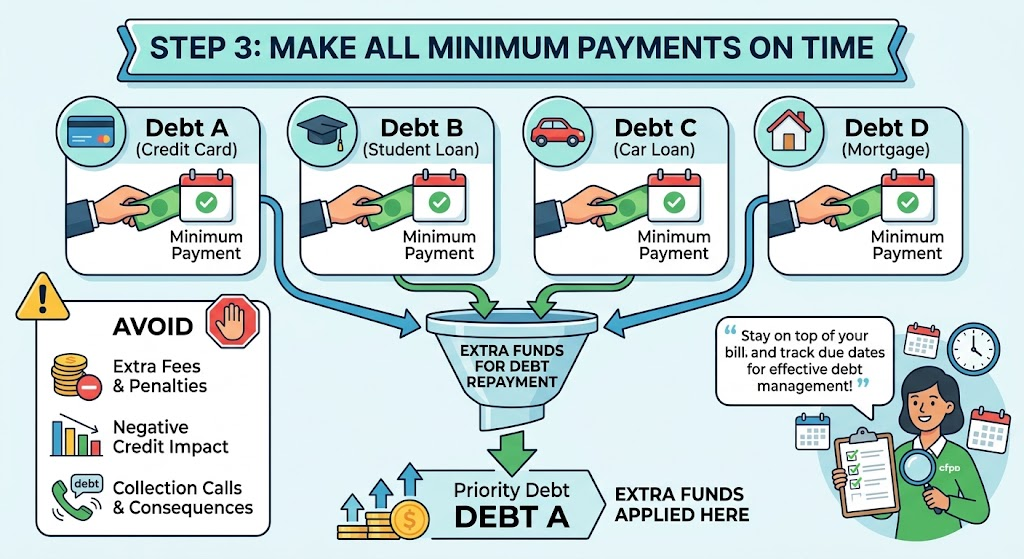
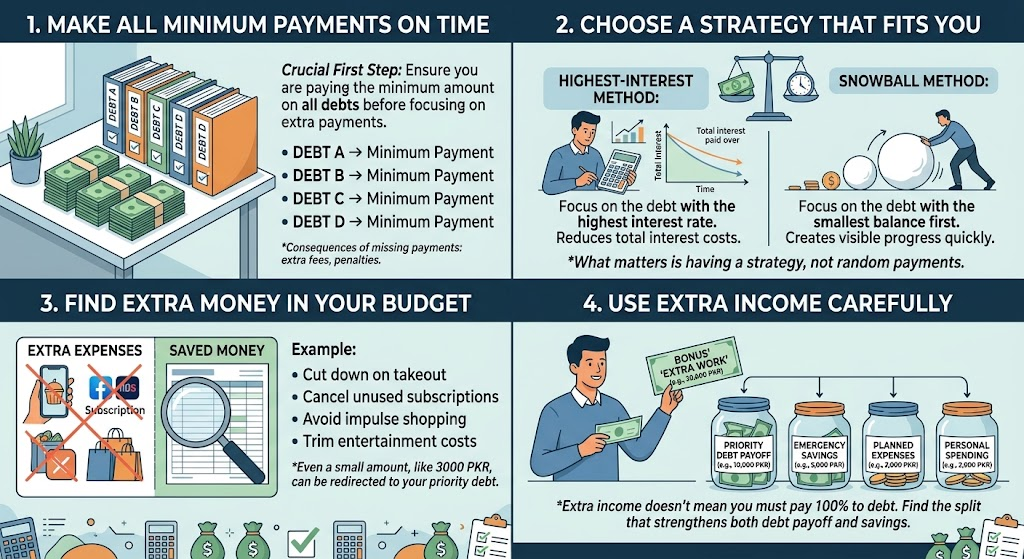
Before you throw all your energy at one particular debt, make sure you’re still keeping up with the minimum payments on everything else.
Missing payments can lead to extra fees, penalties, and other consequences depending on the debt and the lender involved.
So your basic system might look something like this:
Debt A → Minimum payment
Debt B → Minimum payment
Debt C → Minimum payment
Debt D → Minimum payment
Then, whatever extra money you have available for debt repayment goes toward your chosen priority debt.
The CFPB recommends staying on top of your bills and tracking due dates as part of managing debt effectively.
Step 4: Choose a Debt Payoff Strategy
There are two approaches that tend to come up most often.
The Highest-Interest-Rate Method
With this one, you put your extra payment toward whichever debt carries the highest interest rate.
You keep making minimum payments on everything else.
Once that highest-interest debt is gone, you shift the extra payment to the next highest-interest debt in line.
This approach can reduce how much interest you pay overall, since you’re going after the most expensive debt first.
Example
Say you have:
Credit Card A — 25% Credit Card B — 18% Personal Loan — 12%
Your extra payment would go toward Credit Card A first.
Once that balance is cleared, you move on to Credit Card B.
Step 5: Understand the Debt Snowball Method
The snowball method works a bit differently.
Instead of chasing the highest interest rate, you go after the smallest debt balance first.
You keep making minimum payments on the rest, while directing extra money at that smallest balance.
Once it’s gone, you take what you were paying toward it and roll it into the next smallest debt.
The payment amount essentially grows bigger as each debt gets knocked out.
The CFPB describes the snowball method as a strategy that can give you a quicker sense of momentum, since smaller balances tend to disappear sooner — though it can end up costing more in interest compared to tackling the higher-interest debts first.
Example
Imagine:
Debt A — 20,000 PKR Debt B — 60,000 PKR Debt C — 150,000 PKR
You’d work through them in this order:
20,000 → 60,000 → 150,000
as each balance gets paid off.
Step 6: Choose the Method That Fits Your Situation
These two approaches have pretty different personalities.
Strategy Main Focus Potential Advantage Highest-interest method Highest interest rate Can reduce costly interest Snowball method Smallest balance Can create visible progress quickly
Either way, you’re still on the hook for your required payments no matter which method you pick.
What really matters is having a clear strategy instead of randomly tossing extra money at whichever debt crosses your mind.
The CFPB notes that people often lean toward one approach or the other depending on whether they’re more motivated by cutting costs or by seeing quick, visible progress.
Step 7: Find Money You Can Put Toward Debt
Once you’ve settled on a strategy, take a good look at your monthly budget.
You don’t need to magically find thousands of extra rupees right away.
Start by hunting for realistic opportunities instead.
For example:
Cut back on unnecessary food delivery Cancel subscriptions you’re not using Reduce impulse shopping Take another look at entertainment expenses Sell off items you no longer need Pick up occasional freelance work Use part of a bonus or extra payment
Say you manage to free up:
3,000 PKR per month
Instead of letting that quietly vanish into miscellaneous spending, you could send it straight toward your priority debt.
Step 8: Use Extra Income Carefully
Extra income can give your debt payoff plan a real boost.
That could come from things like:
Freelance work Overtime Part-time work A bonus Selling unused belongings A side business A one-time payment
You don’t have to throw 100% of it at debt.
For example:
Extra income: 20,000 PKR
You might split it something like:
10,000 PKR → debt 5,000 PKR → emergency savings 3,000 PKR → planned expenses 2,000 PKR → personal spending
The right split really comes down to your own situation.
Investor.gov notes that lump-sum payments can be used to both reduce debt and strengthen savings at the same time.
Step 9: Build a Small Emergency Cushion
It might feel a bit counterintuitive to save money while you’re actively trying to pay off debt.
But having absolutely nothing set aside for an unexpected expense can create a whole new problem down the line.
Imagine you’re aggressively knocking out a credit card balance.
Then your car suddenly needs a repair.
If you don’t have any accessible savings, you might end up putting that repair right back on the credit card.
And just like that, the debt is back.
That’s why keeping some emergency savings on hand can act as a useful buffer.
Investor.gov describes emergency savings as a way to help cover unexpected expenses without necessarily having to slide back into debt.
Exactly how much you keep aside depends on your own circumstances.
Step 10: Stop Adding New Debt
Paying off debt gets a lot harder if you’re constantly creating fresh balances at the same time.
If you’re paying down a credit card while still using it for purchases you can’t actually afford, the balance may just keep climbing right back up.
Before taking on new debt, ask yourself:
Do I actually need this?
Can I pay for it without borrowing?
Will this create yet another monthly payment?
Will the interest end up making this purchase way more expensive?
These questions can help you pump the brakes before adding one more obligation onto your budget.
Step 11: Review Your Monthly Expenses
Your debt repayment plan isn’t really separate from your regular budget.
The two need to move together.
At the start of every month, take a look at:
Income Housing Food Transportation Utilities Family expenses Savings Debt payments Flexible spending
Then figure out how much extra you can realistically put toward debt.
Investor.gov recommends understanding your income and expenses and factoring debt repayment in alongside your savings and investing goals when you’re organizing your finances.
Step 12: Make Extra Payments When Your Budget Allows
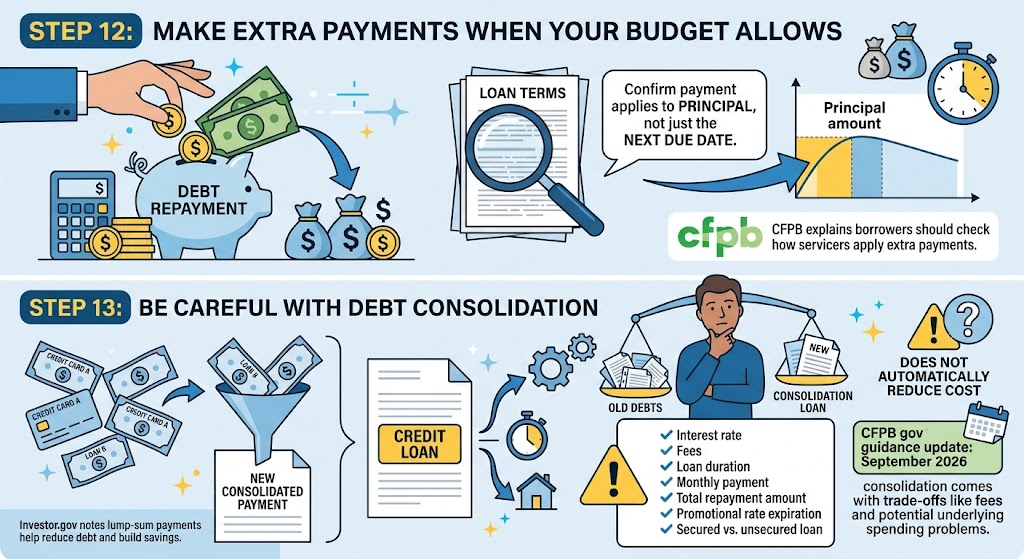
If you’ve got some extra money available, making an additional debt payment can help shrink the balance faster.
For certain loans, it’s especially important to confirm the extra payment is actually going toward the principal, rather than just pushing your next due date further out.
The CFPB explains that borrowers making extra payments on certain loans should check how their servicer applies those payments and, where it makes sense, specifically request that the extra money go toward the principal.
Always double-check the specific terms of your loan before assuming anything.
Step 13: Be Careful With Debt Consolidation
You’ll probably run into ads promising to roll several debts into one simpler payment.
Debt consolidation can change how you manage your debt, sure, but it doesn’t automatically make that debt any cheaper.
Before signing up for a consolidation loan, compare:
Interest rate Fees Loan duration Monthly payment Total amount you’ll end up repaying Any promotional rate that might expire Whether you’re securing the loan against an asset
CFPB guidance updated in September 2026 warns that consolidation can come with real trade-offs — fees, shifting interest rates, and the risk that taking on new debt doesn’t actually fix the underlying spending problem.
Step 14: Be Careful With Debt-Relief Promises
Stay cautious whenever a company promises to make your debt vanish quickly
Watch for red flags like:
“Guaranteed debt forgiveness.”
“Stop paying your creditors immediately.”
“We’ll eliminate your debt for a small upfront fee.”
The CFPB advises people to be wary of debt-settlement companies that make guarantees, charge fees upfront, or tell you to stop communicating with your creditors or stop making payments altogether.
If you’re genuinely struggling with payments, reaching out to your creditor early is usually far more useful than just ignoring the problem and hoping it goes away.
Step 15: Contact Creditors If You’re Struggling
If you honestly can’t afford your required payments, don’t wait around until things get even worse.
Reach out to the creditor and explain:
Why you’re having trouble How much you can currently afford When you expect things to improve What kind of payment arrangement you’re asking for
Based on CFPB guidance, some credit-card companies may be open to discussing payment changes when borrowers are genuinely going through financial difficulty.
The exact options available depend on the creditor and the type of debt involved.
Step 16: Track Your Debt Payoff Progress
Debt repayment can feel painfully slow when you’re staring at similar-looking balances month after month.
Tracking your progress makes the changes a lot easier to actually see.
For example:
January
Total debt: 300,000 PKR
March
Total debt: 275,000 PKR
June
Total debt: 235,000 PKR
September
Total debt: 190,000 PKR
Now you’re not just making payments in isolation.
You’re watching the total number actually move downward.
Worth tracking:
Total debt Individual balances Interest rates Minimum payments Extra payments Payoff dates A Simple Debt Payoff Example
Let’s say someone has three debts:
Debt Balance Interest Rate Minimum Credit Card 80,000 PKR 24% 4,000 PKR Personal Loan 120,000 PKR 15% 6,000 PKR Car Loan 300,000 PKR 10% 10,000 PKR
Their minimum payments add up to:
20,000 PKR a month
Say their budget allows for another:
5,000 PKR
toward debt repayment.
Under a highest-interest approach, that extra 5,000 PKR would go toward the 24% credit-card debt, while minimum payments keep running on the other two.
Once the credit card is cleared, the money that was going toward it gets redirected to the next priority debt in line.
This is just an illustrative example, not a personalized repayment recommendation for your own situation.
What If You Have Multiple Debts?
Don’t let the sheer number of accounts overwhelm you.
Start with one simple list.
Step 1
Write down every debt.
Step 2
Record every balance.
Step 3
Record every interest rate.
Step 4
Record minimum payments.
Step 5
Choose a repayment strategy.
Step 6
Keep up with minimum payments on everything required.
Step 7
Direct extra money toward your chosen priority.
Step 8
Move on to the next debt once one is cleared.
That turns what feels like a messy, overwhelming situation into a series of smaller, manageable tasks.
Common Debt-Payoff Mistakes Paying Random Amounts
Without a real strategy, you can end up spreading extra money across several debts without making meaningful progress on any single one of them.
Ignoring Interest Rates
A high-interest balance can quietly get more expensive the longer it’s left untouched.
Only Making Minimum Payments
Minimum payments will keep an account current, but they can drag out how long it actually takes to eliminate the balance.
Taking on New Debt
New borrowing can undo a lot of the progress you’ve already made.
Draining Every Rupee of Savings
An unexpected expense can send you right back into debt if you’ve got nothing set aside.
Falling for “Easy Debt-Free” Promises
Stay skeptical of companies claiming guaranteed or instant results.
Giving Up Because Progress Feels Slow
Debt reduction is usually a process, not a quick fix.
Keep tracking the numbers anyway.
How to Stay Motivated While Paying Off Debt
Paying off debt can take months, sometimes even years.
So don’t measure success purely by whether you’ve hit “completely debt-free” yet.
Pay attention to smaller milestones too.
For example:
First: Make every payment on time.
Next: Build a small emergency cushion.
Then: Pay off your first debt.
Then: Cut your total debt by 10%.
Then: Keep moving toward the next milestone.
Each of these gives you one more reason to keep going.
What Should You Do With Money After a Debt Is Paid Off?
This part of the process matters a lot.
Say you were paying:
8,000 PKR a month
toward a loan.
Once that loan is gone, you suddenly have an extra 8,000 PKR sitting in your monthly budget.
Try not to just let that money quietly get absorbed into everyday lifestyle spending.
Instead, you could redirect some or all of it toward:
Emergency savings Long-term savings Investing Another debt A planned financial goal
Investor.gov’s broader financial guidance places debt management, emergency savings, and long-term saving and investing all within the same overall financial plan.
Final Thoughts
Figuring out how to pay off debt faster was never about finding some magic shortcut.
It’s about understanding what you owe, getting your payments organized, choosing a strategy, and consistently putting whatever money you can toward your debt.
Start by putting together a complete list of your balances.
Understand the interest rates involved.
Keep up with your required payments.
Then decide whether the highest-interest approach or the snowball approach genuinely fits your situation and what keeps you motivated.
At the same time, try to avoid piling on unnecessary new debt, and keep a little room for unexpected expenses wherever your circumstances allow.
Most importantly, don’t let a big debt number convince you that progress just isn’t possible.
You don’t have to wipe it all out at once.
One balance. One payment. One month at a time.