

Saving money can feel genuinely difficult when most of your income is already spoken for — rent, food, transportation, bills, family expenses, and debt all eating away at what comes in.
When money is tight, advice like “just save 20% of your income” can feel completely out of touch with real life.
The truth is, figuring out how to save money on a low income usually calls for a different kind of approach altogether.
Instead of sitting around waiting for a big chunk of extra money to magically appear, you can focus on understanding where your money actually goes, trimming expenses where you can, setting small, realistic savings targets, and building systems that make saving something that just happens consistently.
Even a fairly small amount, saved regularly, can add up to something meaningful over time.
The goal was never to build a perfect financial life overnight.
It’s to carve out some breathing room and gradually strengthen your financial situation, bit by bit.
Investor.gov recommends getting a handle on your income and expenses, making room for saving, and treating regular saving as part of a bigger financial plan.
Let’s get into how you can actually pull that off.
What Does It Mean to Save Money on a Low Income?
Saving money on a low income really just means setting aside a portion of what you earn instead of spending every last bit of it.
That amount might be small.
For one person, that could mean 1,000 a month.
For someone else, it might be 2,000 or 5,000.
There’s no single universal number that fits everyone here.
Your income, housing costs, family responsibilities, debt, transportation expenses, and other obligations all shape how much you can realistically set aside.
That’s why the first move isn’t really about landing on some magic percentage.
It’s about genuinely understanding your own financial situation first.
Investor.gov recommends tracking your income and expenses and treating savings as its own category within your financial plan.
Why Saving Can Feel So Difficult When Money Is Tight
When your income is limited, there’s often simply not much left once the essentials are covered.
Picture someone earning 50,000 PKR a month.
Their basic expenses might look something like this:
Expense Monthly Amount Housing 15,000 PKR Food 10,000 PKR Transportation 5,000 PKR Utilities 4,000 PKR Family expenses 6,000 PKR Debt payments 4,000 PKR Other essentials 3,000 PKR Remaining 3,000 PKR
In a situation like that, saving 10,000 PKR a month just isn’t realistic unless something major changes.
But saving 1,000–2,000 PKR? That’s probably doable.
That gap right there is the difference between setting a target that’s doomed from the start and building a savings habit that actually sticks.
Step 1: Know Exactly Where Your Money Goes
Before you try to save more, spend some real time understanding your current spending.
For one full month, write down everything — your income and every expense.
Don’t lean entirely on memory here.
Track things like:
Rent or housing Groceries Eating out Transportation Electricity Gas Water Internet Mobile phone Debt payments Education Family support Subscriptions Entertainment Shopping Other miscellaneous expenses
You might be surprised to find certain small expenses happening far more often than you’d assumed.
Investor.gov specifically recommends keeping close track of income and expenses, since understanding your full financial picture can help you spot room for saving and investing.
Step 2: Separate Needs From Wants
This is one of the easiest ways to make sense of your spending.
A need is generally something you require to keep your basic life and responsibilities running.
A want is something nice to have, but something you could technically live without.
Examples of needs: Basic food Housing Essential transportation Utilities Necessary medical expenses Required debt payments Examples of wants: Frequent restaurant meals Expensive upgrades Unnecessary subscriptions Impulse shopping Entertainment purchases Buying the newest version of something you already own
This doesn’t mean every single want has to go.
That’s rarely realistic for anyone.
Instead, ask yourself:
“Can I afford this without hurting the financial goals that actually matter to me?”
That one question alone can lead to noticeably better spending decisions.
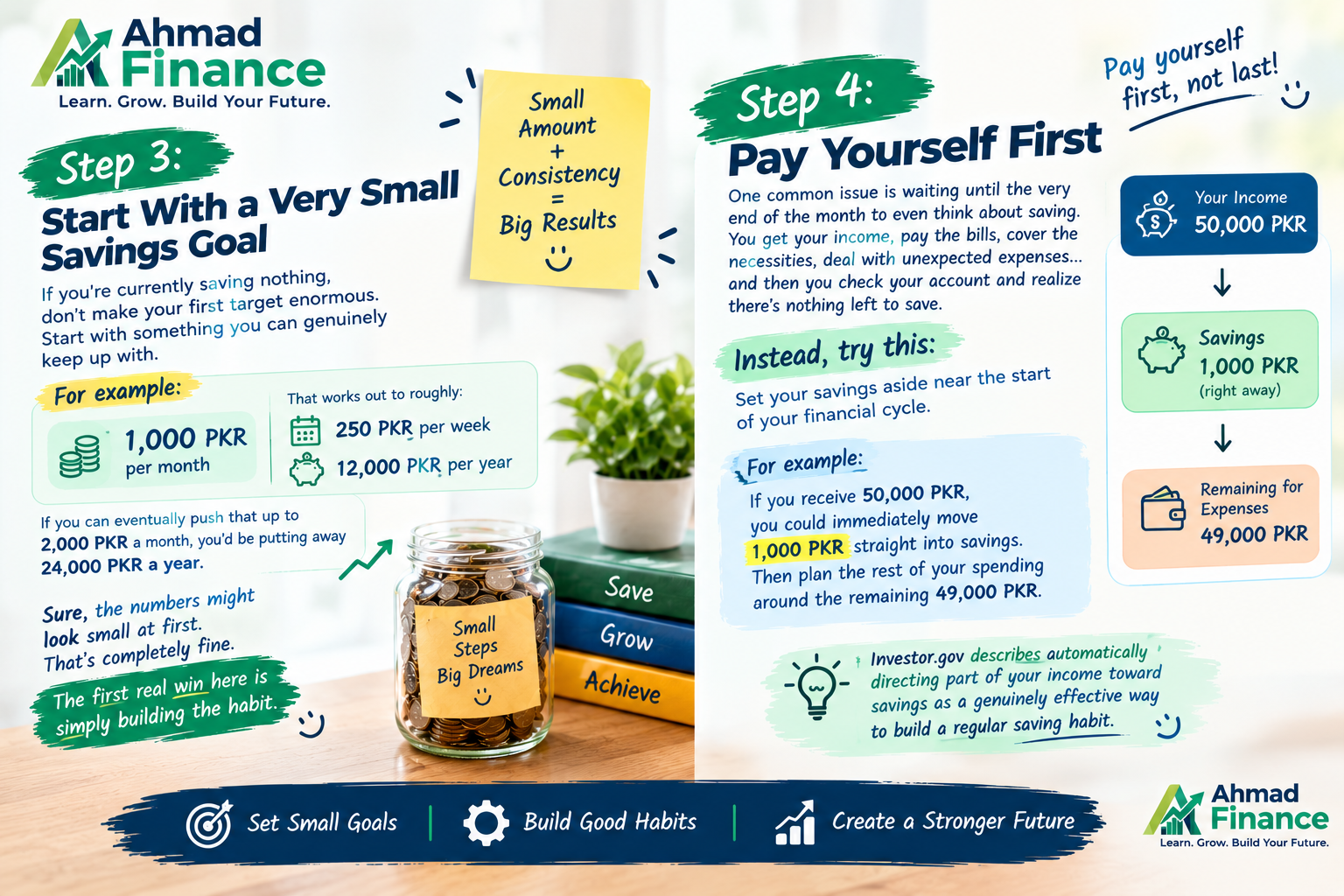
Step 3: Start With a Very Small Savings Goal
If you’re currently saving absolutely nothing, don’t make your first target something enormous.
Start with something you can genuinely keep up with.
For example:
1,000 PKR per month
That works out to roughly:
250 PKR per week 12,000 PKR per year
If you can eventually push that up to 2,000 PKR a month, you’d be putting away 24,000 PKR a year.
Sure, the numbers might look small at first.
That’s completely fine.
The first real win here is simply building the habit.
CFPB guidance emphasizes that saving automatically and consistently can help people grow their savings over time, with the amount and frequency adjusted to fit their own circumstances.
Step 4: Pay Yourself First
One common issue with saving is waiting until the very end of the month to even think about it.
You get your income.
You pay the bills.
You cover the necessities.
You deal with whatever unexpected expense popped up.
And then you check your account and realize there’s nothing left to actually save.
Instead, try setting your savings aside near the start of your financial cycle.
For example, if you receive 50,000 PKR, you could immediately move 1,000 PKR straight into savings.
Then you plan the rest of your spending around the remaining 49,000 PKR.
Investor.gov describes automatically directing part of your income toward savings as a genuinely effective way to build a regular saving habit.
Step 5: Automate Your Savings
If your bank supports recurring transfers, automation can make this whole process much easier.
You get to decide:
How much to transfer How often it happens Which account the money lands in
For example:
1,000 PKR → savings account → every payday
The upside here is simple.
You’re no longer relying on remembering to save every single time.
The transfer just happens, running on the system you’ve already set up.
The CFPB recommends automatic saving as a way to keep contributions consistent, while also reminding people to keep an eye on their balances so those automatic transfers don’t end up causing overdrafts or other headaches.
Step 6: Look for the Expenses You Can Actually Change
Not every expense has room to shrink.
You can’t really cut rent out of existence.
You still need to eat.
You may genuinely need transportation to get to work.
But some expenses do have more give than others.
Take a look at categories like:
Takeaway food Delivery charges Unused subscriptions Entertainment Shopping Premium phone packages Unnecessary transportation Frequent small purchases
Say you notice you’re spending:
300 PKR × 10 times a month = 3,000 PKR
on small purchases.
Cutting back on some of those doesn’t mean giving up enjoyment entirely.
Even trimming that spending by a third would free up around 1,000 PKR.
That could become your entire monthly savings contribution right there.
Step 7: Don’t Ignore Small Expenses
Small purchases feel pretty harmless on their own.
100 PKR doesn’t seem like a big deal.
Neither does 200 PKR.
But repeated small spending adds up fast.
Take this example:
250 PKR × 20 purchases = 5,000 PKR
That’s exactly why tracking your spending for a full month can be so useful.
You might uncover patterns you never noticed before.
The point isn’t to feel guilty over every small purchase.
It’s to genuinely understand your overall spending picture.
Step 8: Use Extra Income Strategically
Sometimes your regular income just isn’t enough to create much room for savings.
In that case, extra income can make a real difference.
Depending on your situation, that could include:
Freelance work Part-time work Selling unused items Online services Overtime Small business income One-time payments
You don’t have to save every single rupee of that extra money.
You could split it instead.
For example:
Extra income: 10,000 PKR
4,000 PKR → emergency savings 3,000 PKR → debt 2,000 PKR → planned expense 1,000 PKR → personal spending
The exact split depends entirely on your own situation.
The key idea is simply not letting every extra rupee quietly disappear into regular spending.
Investor.gov notes that lump-sum payments and extra income can potentially be used to strengthen savings and chip away at debt.
Step 9: Build an Emergency Fund Before Taking Bigger Risks
If you’re starting from zero savings, having some accessible money for unexpected expenses matters a lot.
An emergency fund can help you cover things like:
Unexpected medical costs Essential repairs A sudden loss of income Necessary transportation repairs Urgent family expenses
Without any savings, an unexpected expense can end up forcing you to borrow.
Investor.gov describes an emergency fund as a way to build a cushion for unexpected expenses, potentially reducing the need to take on debt in the first place.
Start small if that’s what it takes.
Your emergency fund doesn’t need to be finished in a single month.
Build it up gradually, over time.
Step 10: Create Separate Savings Goals
One single savings account doesn’t necessarily have to carry every financial goal you have.
Over time, you might create separate categories for:
Emergency Fund
For unexpected financial problems.
Short-Term Goals
For things you expect to pay for within the next few months.
Medium-Term Goals
For bigger purchases or upcoming responsibilities.
Long-Term Goals
For goals that are still years away.
Breaking things up this way can make your progress a lot easier to actually see.
Instead of thinking:
“I only have 20,000 PKR saved.”
you might see it as:
Emergency fund: 12,000 PKR Education goal: 5,000 PKR Planned purchase: 3,000 PKR
Each amount now has a clear purpose behind it.
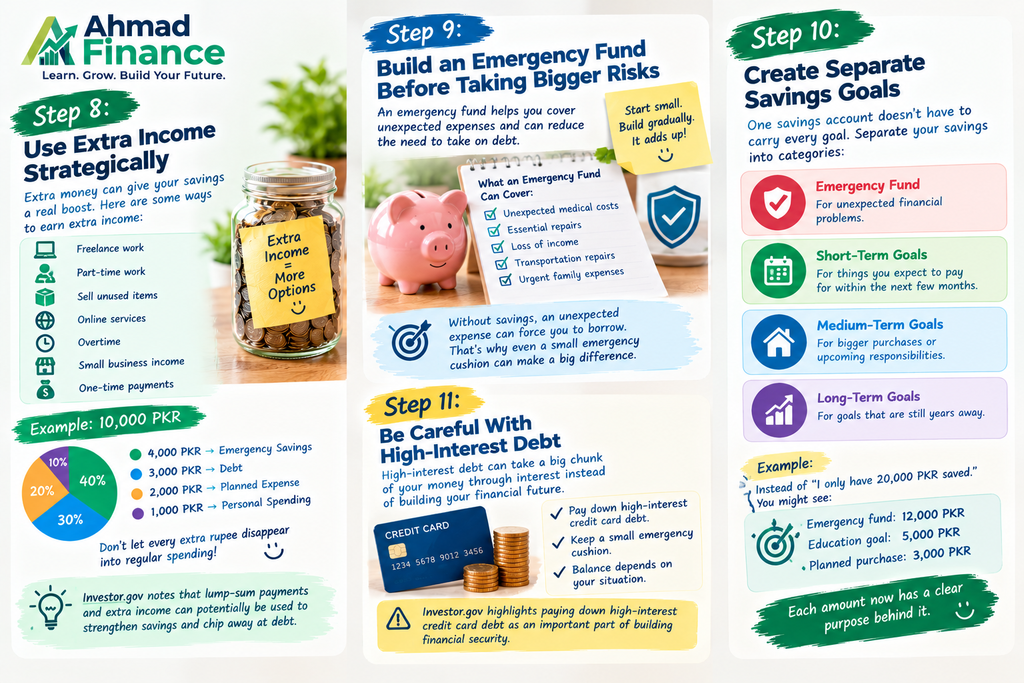
Step 11: Be Careful With High-Interest Debt
Saving matters, but debt can complicate the whole picture.
If you’re carrying expensive high-interest debt, a big chunk of your money may already be going toward interest rather than building your actual financial position.
Investor.gov specifically calls out paying down high-interest credit card debt as an important piece of building financial security.
That doesn’t mean you have to have zero savings while you’re tackling debt, though.
Having even a small emergency cushion can help stop a minor unexpected expense from turning into even more debt.
Where exactly the balance lands depends on your own circumstances.
Step 12: Make Saving Easier by Making Spending Harder
This doesn’t have to mean locking your money away somewhere inaccessible.
It can just mean putting a little distance between your everyday spending money and your savings.
For example:
Account 1: Daily spending Account 2: Emergency savings
When the money isn’t sitting in the same place you use for everyday purchases, you’re generally less likely to spend it without thinking.
What matters most is that your emergency savings stay reasonably accessible whenever a genuine emergency actually shows up.
Step 13: Increase Your Savings When Your Income Increases
Say you’re currently earning:
50,000 PKR/month
and saving:
1,000 PKR/month
Then your income bumps up to:
60,000 PKR/month
Rather than immediately expanding your spending by the full 10,000 PKR, consider putting part of that increase toward savings instead.
For example:
Previous savings: 1,000 PKR Income increase: 10,000 PKR New savings contribution: 4,000 PKR Additional spending room: 6,000 PKR
Now you’re saving more without needing to completely reshape your existing lifestyle.
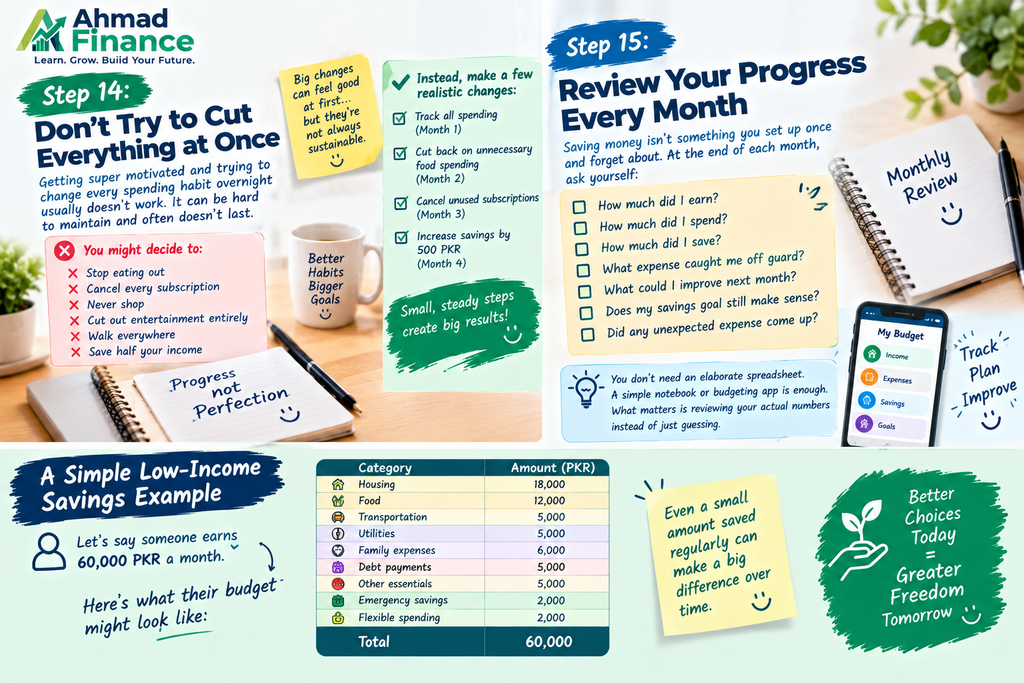
Step 14: Don’t Try to Cut Everything at Once
A pretty common mistake is getting super motivated and trying to overhaul every single spending habit overnight.
You might decide to:
Stop eating out Cancel every subscription Never shop Cut out entertainment entirely Walk everywhere Save half your income
That plan can sound impressive on paper.
But if it’s genuinely impossible to keep up, it probably won’t last very long.
Instead, make a handful of changes you can realistically stick with.
For example:
Month 1: Track all spending.
Month 2: Cut back on unnecessary food spending.
Month 3: Cancel unused subscriptions.
Month 4: Bump savings up by 500 PKR.
Small, steady improvements like these can compound into a much stronger financial routine.
Step 15: Review Your Progress Every Month
Saving money isn’t something you set up once and then never think about again.
At the end of each month, ask yourself:
How much did I earn? How much did I spend? How much did I save? What expense caught me off guard? What could I improve next month? Does my savings goal still make sense? Did any unexpected expense come up?
You don’t need some elaborate spreadsheet for this.
A simple notebook or budgeting app is more than enough.
What matters is reviewing your actual numbers instead of just guessing.
A Simple Low-Income Savings Example
Let’s say someone earns 60,000 PKR a month.
Their budget might look something like this:
Category Amount Housing 18,000 PKR Food 12,000 PKR Transportation 5,000 PKR Utilities 5,000 PKR Family expenses 6,000 PKR Debt payments 5,000 PKR Other essentials 5,000 PKR Emergency savings 2,000 PKR Flexible spending 2,000 PKR Total 60,000 PKR
These numbers are just an illustration.
Your own budget will probably look completely different.
What matters is that savings has actually been given a spot in the budget.
Even 2,000 PKR a month would come out to:
24,000 PKR over a year, assuming the contribution stays consistent and doesn’t get pulled out along the way.
What If You Literally Have Nothing Left to Save?
This is a genuinely important question to sit with.
If your income is entirely swallowed up by essential expenses, the answer isn’t always “cut back even more.”
Sometimes there just isn’t enough income coming in to begin with.
In that case, look at both sides of the equation.
Reduce What You Can
Take another look at:
Housing Food Transportation Subscriptions Debt costs Shopping Other flexible expenses Increase Income Where Possible
Consider things like:
Freelancing Part-time work Selling unused belongings Learning a marketable skill Picking up additional shifts Small business opportunities
Sometimes turning your financial situation around means growing your income rather than endlessly trimming expenses.
Common Mistakes When Trying to Save Money Saving an Unrealistic Amount
If you genuinely can’t stick with the target, bring it down.
A smaller, sustainable goal is usually far more useful than an ambitious one you give up on after two weeks.
Waiting Until the End of the Month
If you wait to see what’s left over, there’s a good chance nothing will be.
Give savings a place in your plan right from the start.
Ignoring Small Purchases
Small, repeated expenses can quietly become a big deal over time.
Using Emergency Savings for Regular Shopping
Keep your emergency fund reserved for genuine, unexpected needs only.
Increasing Spending Every Time Income Increases
When your income grows, it’s worth increasing your savings alongside it too.
Feeling Like Small Savings Don’t Matter
They absolutely do.
The habit itself is a huge part of the value.
How to Make Saving Money Easier
You don’t need some complicated financial system to make this work.
Try a simple routine like this instead:
Every Payday
- Receive income
↓
- Move a small amount to savings
↓
- Pay essential bills
↓
- Set your spending limit
↓
- Track expenses
↓
- Review progress at the end of the month
Then repeat the process.
Over time, you can gradually increase how much you’re saving as your financial situation allows.
Saving Money vs. Investing Money
Saving and investing aren’t really the same thing, even though they get lumped together a lot.
Savings tend to work best for short-term needs and emergency reserves, since you want that money to stay easily accessible.
Investing, on the other hand, is generally meant for longer-term goals and comes with a real element of risk.
Investor.gov explains that savings can be a good fit for short-term goals and emergency funds, while investing offers opportunities for longer-term growth, though it carries more risk along with it.
So if you’re starting from zero, there’s no need to feel pressured into investing every single rupee you manage to find.
First, get clear on your financial priorities.
Build a basic financial cushion.
Then start thinking about longer-term goals and investments based on your own circumstances and how much risk you’re comfortable taking on.
Final Thoughts
Figuring out how to save money on a low income was never about discovering one magical budgeting trick.
It’s about making small, repeatable improvements, one after another.
You might start with just 1,000 PKR.
You might cut back on one unnecessary expense.
You might automate a small transfer.
You might set aside part of an unexpected payment.
You might gradually increase your savings whenever your income improves.
None of these steps needs to completely transform your finances overnight.
What actually matters is building a system that fits your real life.
Start small. Track your money. Save consistently. Increase your savings when you’re able to.
Over time, those small decisions can carve out real financial breathing room and get you ready for the bigger financial goals still ahead.