

Life has a funny way of throwing unexpected expenses at you at exactly the wrong moment.
Your car might suddenly need a repair. A home appliance could just stop working one day. You might get hit with a medical bill you weren’t expecting. Your income might dip for a while. Or a family situation might come up that needs money you hadn’t planned to spend.
Honestly, the expense itself usually isn’t the real problem.
The bigger issue is often simply not having the money available when that expense actually shows up.
That’s exactly where an emergency fund comes in.
An emergency fund is money you deliberately set aside for unexpected expenses and financial emergencies. It’s not about getting rich overnight. It’s about building a financial cushion that gives you room to deal with surprises without immediately reaching for credit cards, loans, or money that was meant for something else entirely.
The Consumer Financial Protection Bureau describes an emergency fund as a cash reserve set aside specifically for unplanned expenses — things like car repairs, home repairs, medical bills, or a sudden loss of income. It also points out that how much someone actually needs really comes down to their own individual circumstances.
Here’s the good part.
You don’t need to start with a huge pile of money.
You can literally start from zero and build your emergency savings up gradually.
Let’s walk through how.
What Is an Emergency Fund?
An emergency fund is a dedicated pool of money you keep aside for unexpected financial situations.
Think of it as your own personal financial safety net.
Picture this: you’ve already worked out your monthly budget, and then your refrigerator suddenly dies on you.
Obviously, that wasn’t in the plan.
Instead of completely blowing up your monthly budget over it, you could dip into your emergency savings to cover the cost.
Other examples worth mentioning:
Major car repairs Unexpected home repairs Medical expenses A temporary loss of income Urgent family expenses Replacing an essential appliance Unplanned travel because of a family emergency Other genuinely unplanned expenses
Here’s the important part though — an emergency fund isn’t meant to turn into your everyday spending account.
It exists for the stuff you couldn’t reasonably see coming.
Why Do You Need an Emergency Fund?
Without any emergency savings, an unexpected expense can turn into debt pretty quickly.
Say you have zero savings and suddenly need to cover a major repair.
You’d probably end up putting it on a credit card or borrowing the money somehow.
That might solve the immediate problem, but it tends to create a new one: paying it back.
Interest and fees can quietly turn a manageable expense into something far more expensive over time. The CFPB notes that financial shocks tend to be harder to bounce back from when people don’t have savings to fall back on, often pushing them toward credit or loans instead.
An emergency fund hands you a different option.
Instead of asking:
“How am I going to borrow this money?”
you get to ask instead:
“How much can I safely pull from my emergency savings?”
That one shift can buy you a surprising amount of breathing room.
How Much Emergency Fund Do You Need?
This tends to be one of the very first questions people ask.
And honestly, there’s no single perfect number that fits everyone.
Your ideal emergency fund depends on things like:
Your monthly expenses How stable your income is Whether you’re self-employed Your household responsibilities Your housing situation Your debt payments How secure your job feels Your regular financial commitments
Someone with steady, predictable income and relatively low expenses is going to have very different needs compared to someone whose income shifts every month.
That’s why it makes more sense to think in stages rather than fixating on one giant number.
You could start with something like:
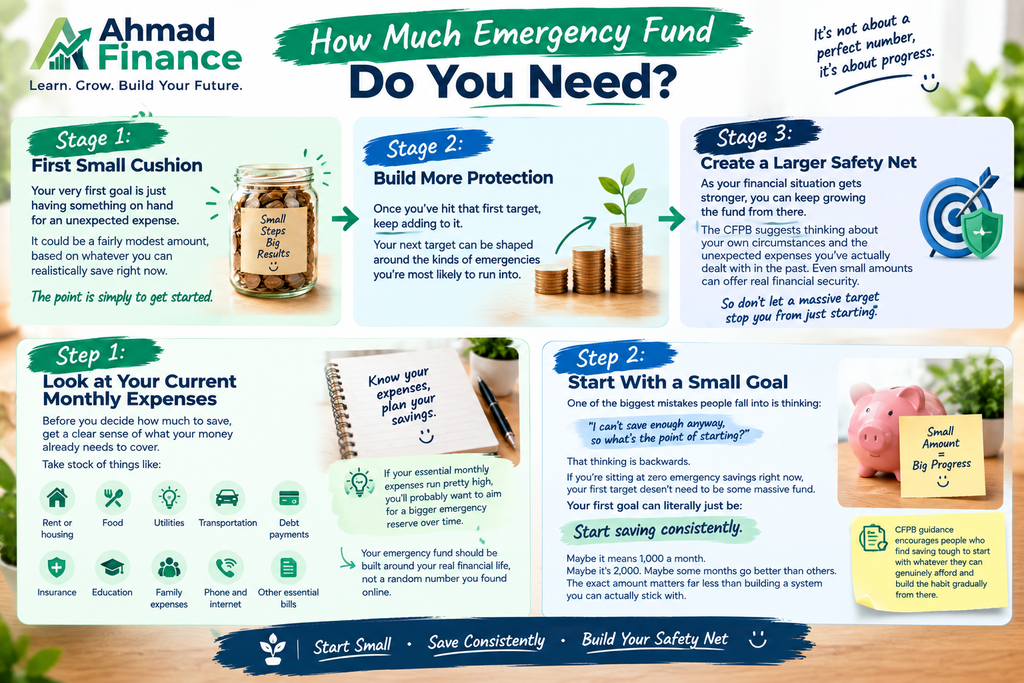
Stage 1: First Small Cushion
Your very first goal is just having something on hand for an unexpected expense.
It could be a fairly modest amount, based on whatever you can realistically save right now.
The point here is simply to get started.
Stage 2: Build More Protection
Once you’ve hit that first target, keep adding to it.
Your next target can be shaped around the kinds of emergencies you’re most likely to run into.
Stage 3: Create a Larger Safety Net
As your financial situation gets stronger, you can keep growing the fund from there.
The CFPB specifically suggests thinking about your own circumstances and the unexpected expenses you’ve actually dealt with in the past when figuring out how much to keep in emergency savings. It also makes a point of saying that even small amounts can offer some real financial security.
So don’t let some massive savings target stop you from just starting.
Step 1: Look at Your Current Monthly Expenses
Before you decide how much to save, get a clear sense of what your money already needs to cover.
Take stock of things like:
Rent or housing Food Utilities Transportation Debt payments Insurance Education Family expenses Phone and internet Other essential bills
This gives you a much clearer picture of your actual financial responsibilities.
For instance, if your essential monthly expenses run pretty high, you’ll probably want to aim for a bigger emergency reserve over time.
Your emergency fund should be built around your real financial life, not some random number you picked up online.
Step 2: Start With a Small Goal
One of the biggest mistakes people fall into is thinking:
“I can’t save enough anyway, so what’s the point of starting?”
That thinking is backwards.
If you’re sitting at zero emergency savings right now, your first target doesn’t need to be some massive fund.
Your first goal can literally just be:
Start saving consistently.
Maybe that means 1,000 a month.
Maybe it’s 2,000.
Maybe some months go better than others.
The exact amount matters far less than building a system you can actually stick with.
CFPB guidance encourages people who find saving tough to start with whatever they can genuinely afford and build the habit gradually from there.
Step 3: Create a Separate Emergency Savings Account
One strategy that actually helps is keeping your emergency savings completely separate from your everyday spending money.
Why does that matter?
Because when your emergency money sits in the same account you use for shopping, dining out, paying bills, and entertainment, it’s way too easy to spend it without even realizing.
A separate account creates a kind of mental boundary.
You start thinking:
This money has a job.
It’s for emergencies, and that’s it.
The CFPB recommends keeping emergency savings somewhere safe and accessible, with a bank or credit union account being one reasonable option.
Exactly which account makes sense will depend on what’s available where you live and your own personal financial situation.
Step 4: Automate Your Savings
This has to be one of the easiest ways to make saving actually happen.
Instead of waiting until the end of the month and just hoping something’s left over, you can set things up so money moves into savings on its own.
For example:
Income arrives → automatic transfer → emergency fund
You’re not relying on remembering to do it every single time.
The CFPB points to automatic recurring transfers as one solid way to make saving more consistent, while also recommending you keep an eye on your account balance so those automatic transfers don’t accidentally trigger overdraft problems.
If your income changes, you can simply adjust the transfer amount.
The important thing is having a system in place at all.
Step 5: Save on Payday
Another straightforward approach is making your emergency savings one of the first things you handle right after your income lands.
Say you get paid for the month.
Instead of spending it all first and saving whatever happens to be left, you move a planned amount toward your emergency fund right away.
That doesn’t mean neglecting your bills or essential expenses.
It just means giving savings an actual place in your financial plan, rather than an afterthought.
Even a small, steady contribution can slowly turn into a meaningful reserve over time.
Step 6: Find Extra Money in Your Existing Budget
You don’t necessarily need to overhaul your entire lifestyle to make this work.
A lot of the time, the money for emergency savings is already hiding somewhere in your budget.
Take a look at things like:
Unused subscriptions Frequent food delivery Unplanned shopping Memberships you’re not using Pricey convenience purchases Impulse spending Services you rarely touch
You don’t have to cut everything out.
Just look for a handful of expenses you genuinely don’t value that much.
For example, trimming 2,000 from unnecessary monthly spending and redirecting it toward emergency savings could add up to roughly 24,000 over a full year.
Consistency is really what does the heavy lifting here.
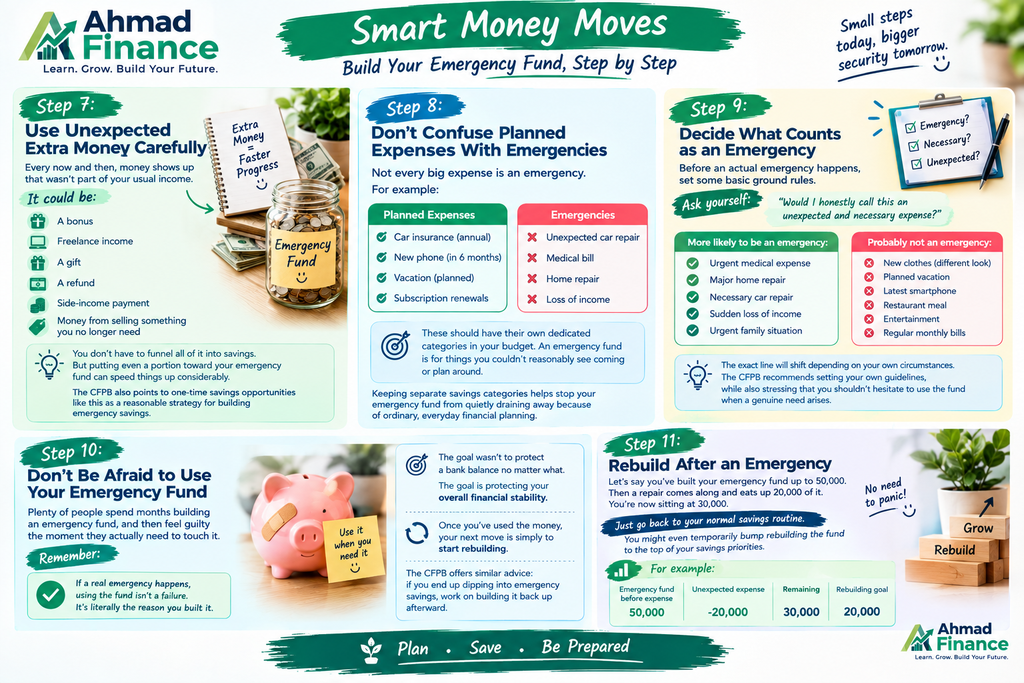
Step 7: Use Unexpected Extra Money Carefully
Every now and then, money shows up that wasn’t part of your usual monthly income.
That could be:
A bonus Freelance income A gift A refund Side-income payment Money from selling something you no longer need
You don’t have to funnel all of it into savings.
But putting even a portion toward your emergency fund can speed things up considerably.
This can be especially helpful when your regular monthly budget is already stretched thin.
The CFPB also points to one-time savings opportunities like this as a reasonable strategy for building up emergency savings.
Step 8: Don’t Confuse Planned Expenses With Emergencies
This one’s genuinely important.
Not every big expense qualifies as an emergency.
For instance, if you know your car insurance is due every year, that’s a planned expense.
If you know you want to buy a new phone six months from now, that’s a planned purchase too.
Ideally, these should have their own dedicated categories within your budget.
An emergency fund is meant for things you couldn’t reasonably see coming or plan around.
Keeping separate savings categories helps stop your emergency fund from quietly draining away because of ordinary, everyday financial planning.
Step 9: Decide What Counts as an Emergency
Before an actual emergency happens, it helps to set some basic ground rules for yourself.
Ask yourself:
Would I honestly call this an unexpected and necessary expense?
For example:
More likely to be an emergency: Urgent medical expense A major, essential home repair A necessary car repair Sudden loss of income An urgent family situation Probably not an emergency: New clothes because you want a different look A planned vacation The latest smartphone A restaurant meal Entertainment Regular monthly bills
The exact line will shift depending on your own circumstances.
The goal is just to have a guideline in place before emotions take the wheel.
The CFPB recommends setting your own personal guidelines for what counts as an emergency, while also stressing that people shouldn’t hesitate to actually use the fund when a genuine need arises.
Step 10: Don’t Be Afraid to Use Your Emergency Fund
This might sound a little strange, but it matters.
Plenty of people spend months carefully building up an emergency fund, and then feel guilty the moment they actually need to touch it.
Remember what the money is actually there for.
If a real emergency happens, using the fund isn’t a failure.
It’s literally the reason you built it in the first place.
The goal was never to protect a bank balance no matter what.
The goal is protecting your overall financial stability.
Once you’ve used the money, your next move is simply to start rebuilding.
The CFPB offers similar advice: if you end up dipping into emergency savings, work on building it back up afterward.
Step 11: Rebuild After an Emergency
Let’s say you’ve built your emergency fund up to 50,000.
Then a repair comes along and eats up 20,000 of it.
You’re now sitting at 30,000.
No need to panic.
Just go back to your normal savings routine.
You might even temporarily bump rebuilding the fund to the top of your savings priorities.
For example:
Emergency fund before expense: 50,000 Unexpected expense: -20,000 Remaining: 30,000 Rebuilding goal: 20,000
Once you’ve replaced what you used, you can shift your focus back to your larger savings goals.
Step 12: Track Your Progress
Saving money becomes a lot easier to stick with when you can actually watch the progress happen.
You could track it like this:
Month Contribution Emergency Fund January 2,000 2,000 February 2,000 4,000 March 2,000 6,000 April 3,000 9,000 May 2,000 11,000 June 3,000 14,000
The numbers themselves don’t need to be huge.
What matters is watching that balance climb, even slowly.
You can track it with a spreadsheet, a budgeting app, an old-fashioned notebook, or whatever tools your bank already offers.
Step 13: Increase Your Savings When Your Income Increases
Your emergency fund contribution doesn’t have to stay frozen forever.
If your income goes up, it’s worth considering bumping your savings contribution up too.
For example:
Current income: 80,000 Emergency savings: 2,000/month
Later on:
Income: 100,000 Emergency savings: 3,000/month
You don’t have to raise it every single time your income shifts even slightly.
But whenever your financial situation genuinely improves, it’s worth revisiting your savings strategy.
A Simple Emergency Fund Example
Let’s say someone brings in 100,000 a month.
Their current budget lets them save 5,000 a month comfortably.
They decide it’s time to build an emergency fund.
Their plan might look something like this:
Month Monthly Saving Total Month 1 5,000 5,000 Month 2 5,000 10,000 Month 3 5,000 15,000 Month 4 5,000 20,000 Month 5 5,000 25,000 Month 6 5,000 30,000
After six months, they’ve built up a 30,000 emergency cushion.
That’s not necessarily their final destination.
But it’s real, tangible progress.
And that’s really what counts.
What If You Can Only Save a Small Amount?
Don’t let small numbers get you down.
If right now you can only manage to save a little, then start with that.
Your financial situation is likely to change down the road.
Your income might go up.
You might cut back on some expense.
You might pick up extra income somewhere.
You might get a bonus at some point.
You might simply get better at managing your money over time.
Your emergency fund can grow right alongside your financial situation as it evolves.
The CFPB’s own guidance specifically acknowledges that people with a limited ability to save can still benefit from setting aside even small amounts.
Common Emergency Fund Mistakes
- Waiting Until You Can Save a Huge Amount
You don’t need some perfect starting point.
Start with whatever you can realistically manage.
- Keeping Emergency Money in Your Spending Account
This makes it far too easy to spend accidentally.
A separate account can help draw a clearer line.
- Using Emergency Savings for Every Want
A sale isn’t an emergency.
A vacation isn’t automatically an emergency either.
Neither is a new gadget.
Protect what the fund is actually for.
- Never Using the Fund
If something genuinely qualifies as an emergency, use the money.
That’s the entire reason you built it.
- Forgetting to Rebuild It
After you use the fund, rebuilding it needs to become part of your financial plan again.
Where Should You Keep Your Emergency Fund?
Generally speaking, emergency savings should sit somewhere safe and easy to access.
The CFPB specifically talks about options like bank or credit union accounts, and it puts real emphasis on accessibility when picking where to keep your emergency savings.
The things that matter most:
Can you actually get to the money when you genuinely need it? Is the money reasonably protected? Are there any unnecessary fees eating into it? Is it kept separate enough from your everyday spending? Do you actually understand the account’s rules?
Don’t pick an account purely because it promises a slightly higher return, if getting to that money during an actual emergency turns out to be difficult or costly.
Your emergency fund is doing a completely different job than long-term investing.
Emergency Fund vs. Investing
These two things are related, but they’re not the same thing at all.
An emergency fund is mainly about resilience and being able to access your money quickly.
Investing is generally about working toward longer-term financial goals while accepting some level of investment risk along the way.
If you don’t have any emergency savings in place, an unexpected expense could force you to sell off investments at exactly the wrong moment.
That’s part of why it helps to think about your emergency savings as something separate from your long-term investment strategy.
Final Thoughts
Building an emergency fund from scratch can feel intimidating at first.
But you don’t have to figure out your entire financial future in a single month.
Start with a realistic amount.
Set up a separate place to keep the money.
Automate your contributions if that fits your situation.
Look for unnecessary expenses you can redirect toward savings instead.
Keep track of your progress along the way.
And when life eventually throws an unexpected expense your way, use the fund exactly as intended.
Then rebuild it.
The goal was never perfection.
The goal is gradually creating a financial cushion that gives you more options when the unexpected happens.
Start small. Stay consistent. Build your safety net one contribution at a time.
That’s really how an emergency fund grows from nothing into a meaningful part of your overall financial plan.